
Popular Intermittent Fasting Protocols Explained
Intermittent fasting includes several time-based eating patterns that alternate between fasting and eating periods. These approaches are widely discussed in general wellness and lifestyle contexts. This article provides a neutral, educational overview of some of the most commonly known intermittent fasting protocols.
This content is for informational purposes only and does not recommend or endorse any specific fasting method. Individual experiences may vary, and professional medical guidance is always advised before making dietary changes.
What Are Intermittent Fasting Protocols?
Intermittent fasting protocols define when you eat rather than what you eat. Each protocol is structured around a daily or weekly schedule that includes a fasting window and an eating window.
The protocols below are described based on how they are commonly defined in general wellness discussions and public resources.
16:8 Intermittent Fasting
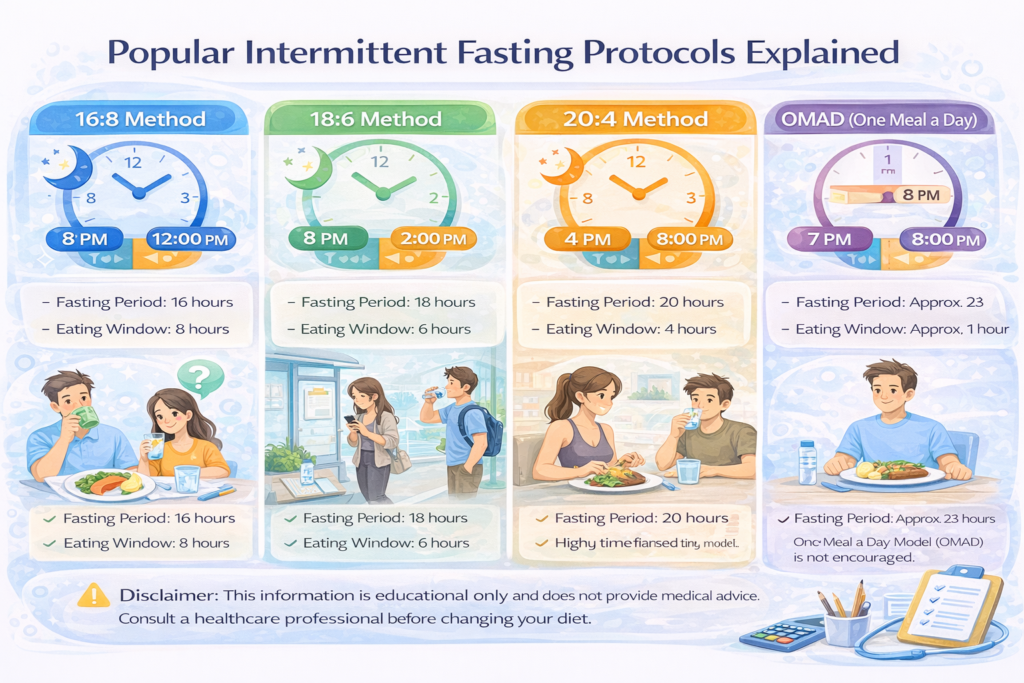
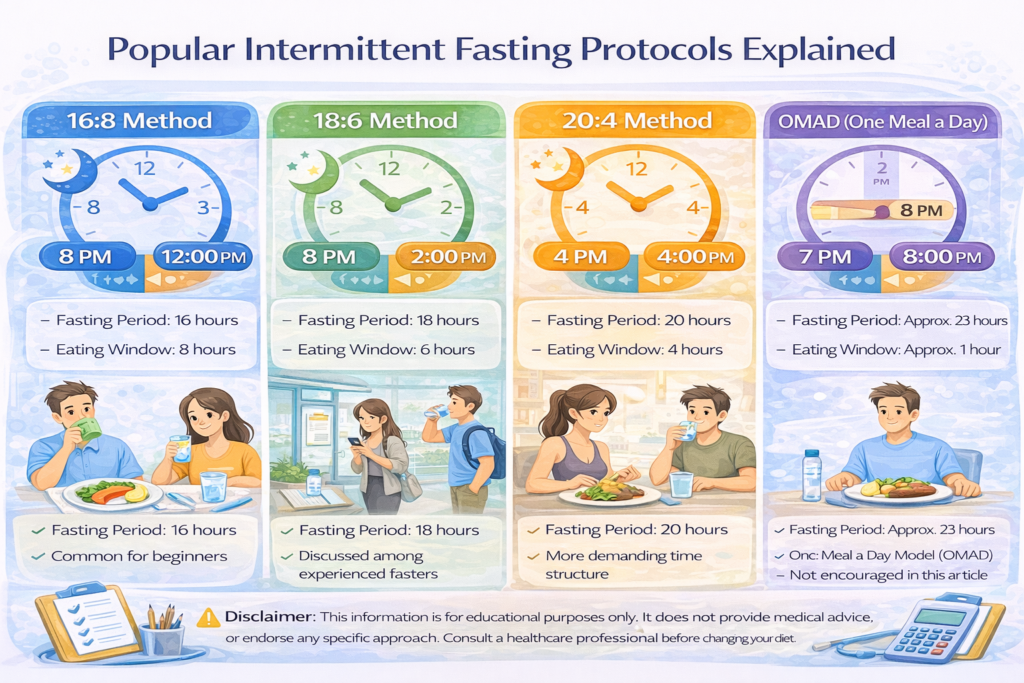
The 16:8 method involves fasting for 16 hours and consuming meals within an 8-hour eating window each day.
- Fasting period: 16 hours
- Eating window: 8 hours
- Often aligned with daytime eating schedules
This protocol is frequently mentioned in beginner-level discussions because of its relatively simple daily structure. However, it may not be suitable for everyone.
18:6 Intermittent Fasting
The 18:6 protocol extends the fasting period slightly longer than 16:8, allowing a 6-hour eating window.
- Fasting period: 18 hours
- Eating window: 6 hours
- Typically requires more schedule planning
This approach is generally described as a more time-restricted variation and is often discussed among individuals already familiar with time-based eating patterns.
20:4 Intermittent Fasting
The 20:4 method, sometimes referred to as a “warrior-style” schedule, includes a 20-hour fasting period and a 4-hour eating window.
- Fasting period: 20 hours
- Eating window: 4 hours
- Highly time-restricted structure
Because of the narrow eating window, this protocol may feel more demanding and is typically discussed as an advanced or short-term structure in educational contexts.
OMAD (One Meal a Day)
OMAD stands for “One Meal a Day” and is a form of intermittent fasting where all daily food intake occurs in a single meal.
- Fasting period: approximately 23 hours
- Eating window: approximately 1 hour
- Highly restrictive timing model
OMAD is often mentioned in fasting discussions for descriptive purposes only. It is not encouraged or recommended in this article, as individual nutritional needs can vary significantly.
Choosing a Fasting Protocol
There is no universal fasting protocol that works for everyone. Factors such as lifestyle, work schedule, health conditions, and personal preferences all influence suitability.
Using planning tools or calculators may help users visualize schedules, but such tools should be considered reference aids rather than decision-makers.
Important Disclaimer
This article is intended for general educational purposes only. It does not provide medical advice, diagnosis, or treatment.
Before starting or changing any fasting routine, individuals should consult a qualified healthcare professional, especially if they have existing medical conditions, are pregnant, nursing, or taking medication.